Every great story begins
with a blank page.
Your masterpiece belongs on it.
To the architects of new worlds.
To the dreamers who stare at the dark until they see light.
To those who know that fiction is the truth inside the lie.
This is for you.
“Finally, a writing tool that doesn't get in the way.”
— Elena R., Fantasy Author
“The AI understands context better than anything else I've tried.”
— Michael K., Sci-Fi Writer
“I plotted my entire trilogy in a weekend. Game changer.”
— Sarah J., Romance Novels
The Struggle
It starts with a spark. A character's voice. A scene so vivid it feels like a memory. You sit down, ready to pour it onto the page.
Then, the friction sets in. The blinking cursor becomes a taunt. The story gets tangled in a web of lost notes, forgotten details, and the crushing weight of “is this good enough?”
The wind howled through the trees.
It was a dark and stormy night, and the forest was alive.
The ancient oaks groaned, their roots gripping the earth like desperate fingers.
Writing a novel is an act of endurance. It is one of the hardest things a human can do. But let us be clear: The problem isn't your imagination. The problem isn't your talent.
The problem is that you're trying to build a cathedral with a plastic spoon. You don't need to try harder. You just need tools that respect the magnitude of your vision.
The Discovery
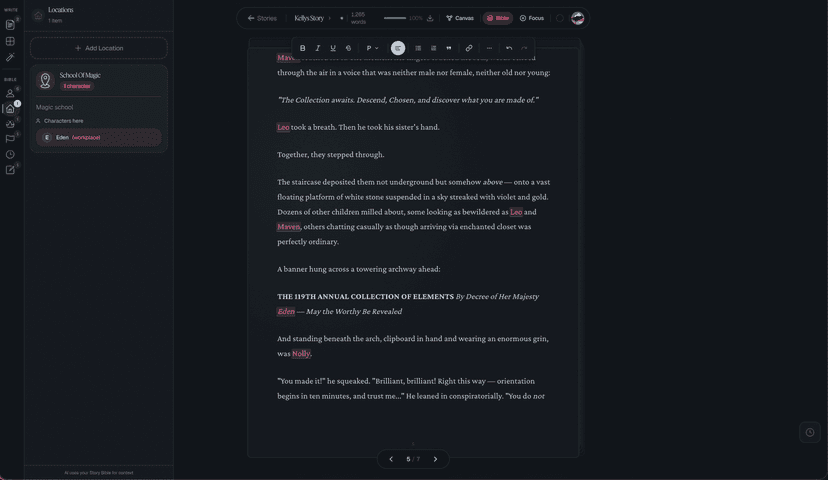
Imagine a place where your characters live and breathe alongside your words. Where the AI knows Elena is determined, that Marcus is skeptical, that Willow Creek holds ancient secrets.
The Discovery
The ancient library held its breath as Elena stepped through the archway. Dust motes danced in the pale light streaming through stained glass windows, each particle a tiny witness to centuries of forgotten secrets.
Marcus followed close behind, his usual skepticism softened by wonder. “Are you sure about this?” he whispered, his voice barely disturbing the sacred silence...
 AI suggestion — Press Tab to accept
The AI knew Marcus was skeptical. It remembered.
The Characters Come Alive
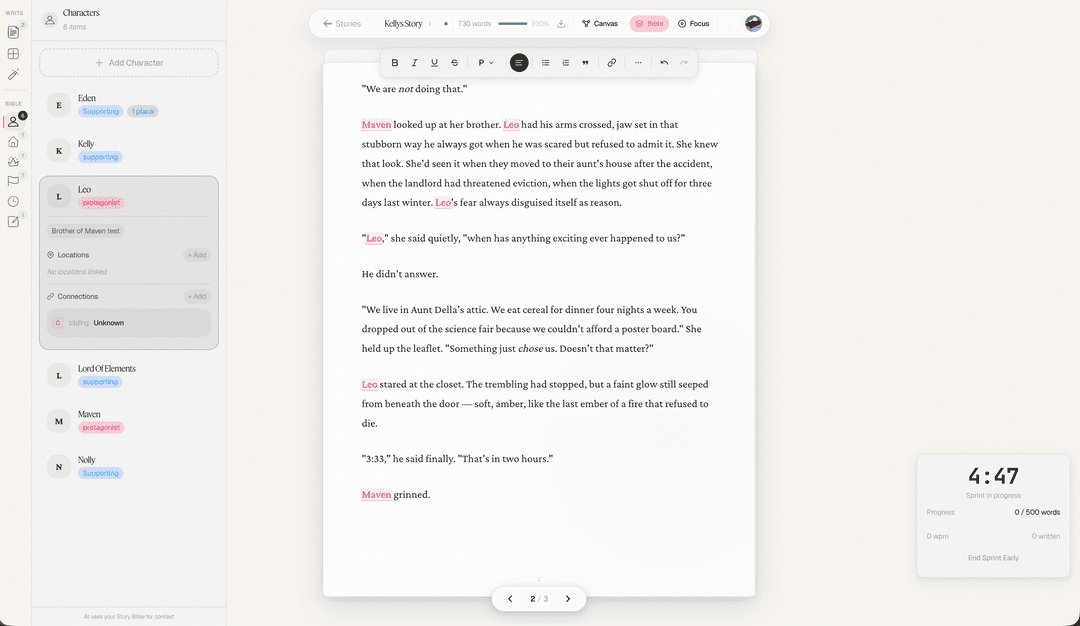
Every character you create becomes part of your world's memory. Their traits, their fears, their deepest secrets—all woven into the fabric of your story.
- Elena is determined and curious—the AI writes her that way
- Marcus always questions first—his dialogue reflects it
- Willow Creek is misty and mysterious—every scene remembers
Elena Rivers
Protagonist
28-year-old botanist. Inherited her grandmother's gift. Green eyes. Always carries a worn leather journal.
Marcus Chen
Best Friend
Location
Willow Creek
Misty valley town. Ancient oak trees. The veil between worlds grows thin here.
The Digital Muse
Your co-author, not your replacement. Tools that help you craft, paint, and ideate without getting in your way.
Story Enhancer
Turn "rough draft" into "published".
The room was quiet. She felt very sad about what happened yesterday. It was raining outside.
Silence hung heavy in the air, broken only by the rhythmic drumming of rain against the glass. A hollow ache settled in her chest, pressing against ribs that felt somewhat fragile.

Sensory Engine
Paint with words in a single click.
AI:The stained glass cast bleeding colors across the stone floor, painting the dust motes in shades of ruby and sapphire.

Idea Generator
Your 24/7 brainstorming partner.
How about a plot twist where the detective realizes the "victim" staged their own disappearance?
I like that. Give me 2 different motives.
- The detective is the victim's ghost.
- The weapon was a memory.
“The tools disappear. The story remains.”
Join thousands of fiction writers who found their creative home.
The Purist
But what if you want silence?
We believe technology should serve you, not distract you. That's why we built Purist Mode.
One click, and the AI sleeps. No suggestions. No ghostly text. It's just you, the cursor, and the infinite potential of the blank page. Because sometimes, the only voice you need to hear is your own.
"The silence is not empty.
It represents potential."
The Environment
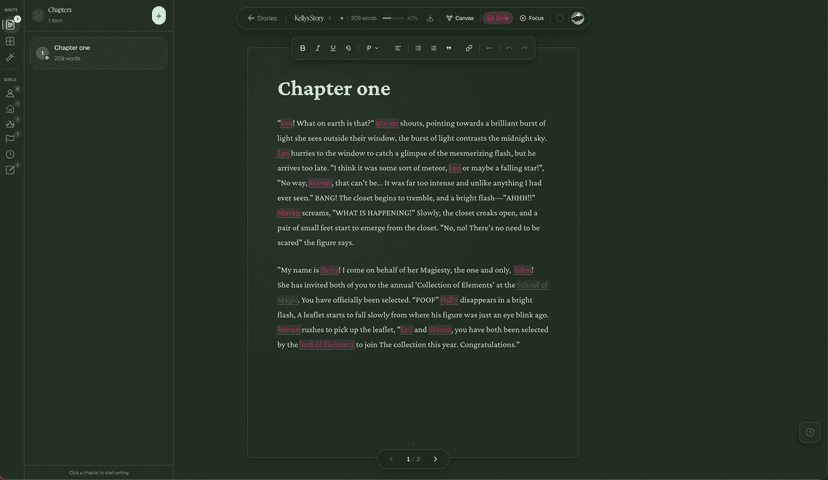
Your writing space should reflect your mindset. From crisp morning clarity to late-night immersion.
Your space, your vibe.
Switch modes instantly. Reduce eye strain with Dark Mode, or go distraction-free with Sepia.
The Paper Garden
The Writers Speak
Stories from the writers who brought their stories to life.
“It wasn't about the speed for me. It was the consistency. The Story Bible remembered the color of a minor character's coat from Chapter 3 when I brought him back in Chapter 28. That kind of continuity is priceless for literary work.”
Sarah Mitchell
Literary Fiction
87,000 words
“I was skeptical. Really skeptical. But then it pointed out a massive plot hole in my second act. It didn't try to fix it for me—it just showed me where I broke it. Exactly the kind of 'ruthless editor' energy I needed.”
James Thornton
Thriller / Mystery
112,000 words
“Coming from Scrivener, this felt like taking a deep breath. No steep learning curve, no clutter. Just open, write, export. It's the simplest path to a finished book I've found so far.”
Priya Sharma
Fantasy Romance
94,000 words
“Stuck? The brainstorming tool is weirdly good. Like, 'scary good' good. It threw out an idea for a subplot involving a temporal paradox that ended up becoming the emotional core of the entire book. I would've never found that thread on my own.”
Marcus Rivera
Science Fiction
53,000 words
“1,500 words before breakfast. Every day. The sprints feature gamified the one part of this job I struggle with: actually sitting down to do the work. It built my habit from scratch.”
Emily Chen
Contemporary Fiction
41,000 words
“I tried using ChatGPT for my world-building, but it kept forgetting my magic system rules halfway through the conversation. This feels different. It holds the entire context of my series. It doesn't just guess based on internet tropes; it actually knows *my* world.”
David Okafor
Epic Fantasy
156,000 words
The world is waiting for your story.
The blank page doesn't have to be intimidating. Not when you have a space that remembers, that understands, that grows with your story.